If you are wondering how to become an insurance adjuster, the short version is this: choose the kind of adjusting you want to do, get licensed in the right state, add skills that carriers and independent firms look for, and then apply where new adjusters actually get hired. You do not need a specific degree, and many people go from first study session to licensed adjuster in a few weeks. This guide walks through each step, what it costs in time and money, and what to expect in your first year.
What an insurance adjuster actually does
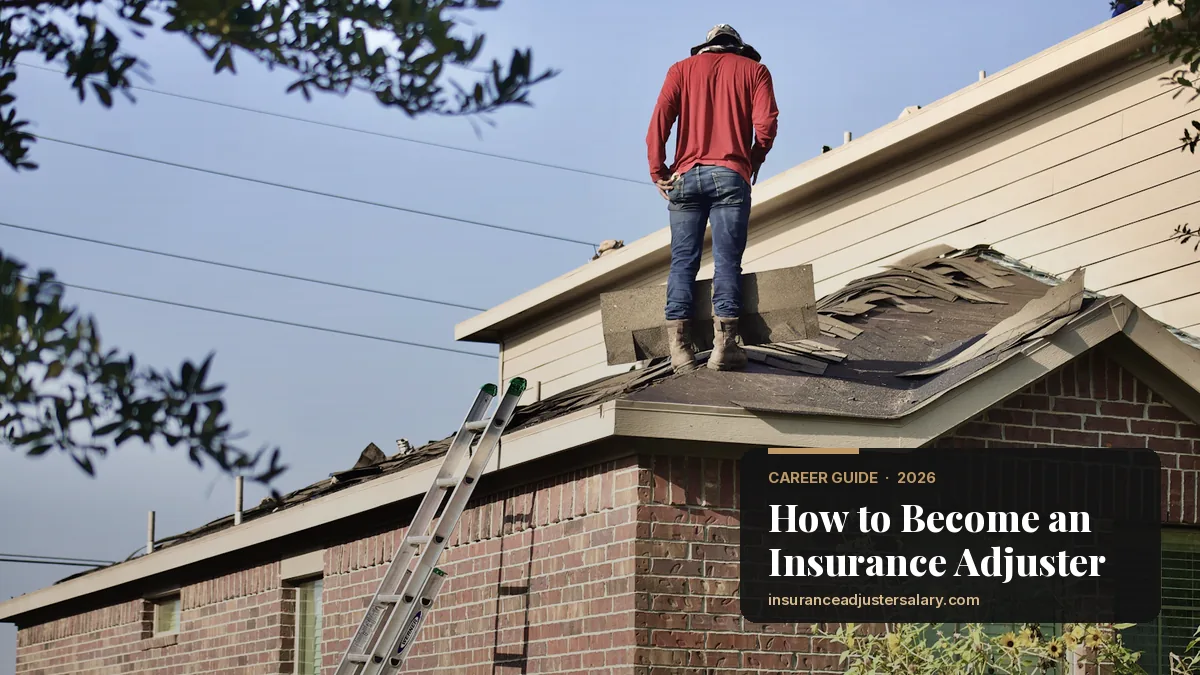
An insurance adjuster investigates a claim, figures out what the policy covers and puts a dollar amount on the loss. Day to day, that means talking with policyholders, inspecting damaged homes or vehicles, taking photos and measurements, writing an estimate, reading policy language and documenting every decision in the claim file. Some adjusters work entirely at a desk handling phone and photo claims. Others spend most of the day in the field climbing roofs and walking through water-damaged homes.
The work also changes with the calendar. A quiet month might mean a steady flow of routine claims, while a hurricane or hail outbreak can bring weeks of long days, travel and hundreds of new files. Good adjusters stay organized, keep notes current and return calls promptly even when volume spikes.
Before you invest in a license, it helps to know which version of the job you want, because the path and the pay are different for each.
Step 1: Choose the type of adjuster you want to become
There are three main types of adjusters. All of them handle claims, but they work for different people and get paid in different ways.
| Path | Who you work for | How you are paid | Good fit if you want |
|---|---|---|---|
| Staff adjuster | An insurance company | Salary plus benefits, often a company car for field roles | Steady income, training and a predictable schedule |
| Independent adjuster (IA) | Independent adjusting firms hired by carriers | Per claim on a fee schedule, or a daily rate for desk work | Higher upside, travel and storm deployments |
| Public adjuster (PA) | The policyholder | A percentage of the claim settlement | Running your own book of business |
Most new adjusters start as staff trainees or in desk roles, then move to field or independent work once they have a few hundred files behind them. For a closer look at the money side of each path, see our guides to claims adjuster salary, independent adjuster salary and public adjuster salary.
Lines of business
Within each path you will also choose a line of business. Property adjusters handle homes and buildings after wind, hail, fire and water losses. Auto adjusters handle vehicle damage and injury claims. Casualty and liability adjusters handle injury and third-party claims, and workers comp adjusters manage workplace injury claims. Property and auto are the most common starting points because they hire in volume.
Step 2: Get your adjuster license
Licensing is the one step nobody can skip when working out how to become an insurance adjuster. Most states require adjusters to be licensed, and even in states that do not, carriers and independent firms want to see a license on your resume. The basic sequence looks similar almost everywhere:
- Pick your home state license. If your state licenses adjusters, you will usually start there. If it does not, you can choose a designated home state (DHS) license from a state such as Texas.
- Take a pre-licensing course. Courses cover policy language, claims handling, ethics and state law. In some states, including Texas, an approved certification course can satisfy the exam requirement.
- Pass the course final or the state exam. Follow the route your state and course provider allow, and keep your completion certificate.
- Get fingerprinted and apply. Many states, Texas included, require fingerprints for a background check. You then apply online, typically through NIPR or Sircon.
- Keep it active. Licenses renew on a set cycle (every two years in Texas) and require continuing education hours before each renewal.
Requirements, fees and exam formats change, so confirm the current rules on your state insurance department's website before you pay for anything.
The Texas all-lines license is the one most adjusters nationwide carry, because it works as a DHS license and has broad reciprocity. Our Texas adjuster license guide covers that route in detail. If you want to study online at your own pace, the AdjustingOnline Texas all-lines pre-licensing course is built for it; use joe20 for 20% off.
Study materials that help
A course is the core of your prep, but many people like a printed review book and practice questions on the side. Two popular options on Amazon are the Claims Adjuster Exam Secrets Study Guide from Mometrix, a general review of exam topics, and Texas All Lines Adjuster: Pre-Licensing Exam Prep if you are going the Texas route. Check that any book matches your state and the current year's exam outline.
Step 3: Add reciprocal state licenses
If you plan to stay a staff adjuster in one state, one license may be all you need. If you want independent or catastrophe work, more licenses mean more deployments. After a major storm, independent firms fill rosters with adjusters who are already licensed in the affected state, and you will not get the call without one.
The usual order for storm-focused adjusters is a home state or Texas DHS license first, then Florida, then Gulf Coast and Southeast states. Florida is the busiest hurricane market and also issues emergency licenses after declared disasters, but a permanent license keeps you on the roster year-round. Because many states recognize the Texas license, adding non-resident licenses is often a paperwork and fee step instead of another exam. See our Florida adjuster salary guide for why so many adjusters add it next.
Step 4: Learn estimating software and claim basics
A license proves you know the rules. Software skills prove you can write a usable estimate. For property claims, Xactimate is the estimating program most carriers and independent firms expect, and practically every property adjuster job posting mentions it. Auto adjusters use their own estimating platforms, which employers usually train on.
Ways to build these skills before your first job:
- Xactimate training and certification. Formal training and a certification level on your resume make you more attractive to independent firms, especially for property and storm work.
- Roof and construction basics. Learn roof pitch, squares, shingle types, siding and drywall terms. Adjusters who can read a roof write better estimates and get fewer reinspections.
- Policy language. Practice reading a homeowners policy's declarations, coverages, exclusions and conditions until you can explain them in plain words.
- Report writing. Clear, short, factual reports are a big part of the job and a common reason firms keep calling the same adjusters back.
Step 5: Gear up if you plan to work in the field
Desk adjusters need little more than a reliable computer and a headset. Field property adjusters and independent adjusters, on the other hand, usually supply their own equipment. Staff field adjusters often get some gear from their employer, so ask before you buy. Common items for a new field adjuster include:
| Item | What it is for | Example |
|---|---|---|
| Multi-position ladder | Reaching roofs and second stories; folds to fit in a vehicle | Little Giant Velocity 18 ft ladder |
| Laser distance measure | Fast room and elevation measurements for estimates | Bosch GLM100-23 laser measure |
| Roof fall protection kit | Harness, lifeline and anchor for steep or high roofs | Guardian 00815 rooftop safety kit |
| Tape measure, chalk and pitch gauge | Marking test squares and measuring roof pitch | Any sturdy contractor-grade set |
| Laptop, phone and battery backup | Photos, estimating software and uploads from the road | Check your firm's software requirements first |
Safety matters more than speed. Learn proper ladder setup, wear shoes with good roof traction, and never climb a roof that is wet, too steep or beyond your training. Fall protection only helps if it is anchored and worn correctly, so get trained on it before you rely on it. Remember that independent adjusters pay for this equipment themselves, along with travel, fuel and software, which is why our CAT Deployment Earnings Calculator includes expenses.
Step 6: Land your first adjuster job
With a license and some basic skills, these are the most common ways in:
Carrier trainee programs
Large insurers run training classes for new staff adjusters, often in auto or property. Some even hire before you are licensed and pay for the license during onboarding. Trainees usually start at the bottom of the entry-level band and move up once they can handle files on their own. Our entry-level claims adjuster salary guide shows what that first rung typically pays.
Desk CAT roles
After a large storm, carriers and vendors staff remote desk teams to handle the surge. These roles commonly pay a daily rate and are a common first job for newly licensed adjusters because they teach claim volume fast without the travel.
Independent adjusting firm rosters
Register on the online rosters of several independent firms, list every license and certification you hold, and keep your profile current. New IAs often start with daily claims or smaller storms before getting large deployments. Being reachable and ready to travel when a storm hits counts for a lot.
Related experience
Backgrounds in roofing, construction, auto repair, customer service, the military or law enforcement translate well. Put those skills front and center on your resume, along with the license number and any Xactimate training.
Step 7: Know what new adjusters earn
Pay depends on path, line of business, location and storm activity, so treat any single number with care. As a reference point, the Bureau of Labor Statistics reports a national median of $76,790 per year (May 2024) for claims adjusters, appraisers, examiners and investigators. By our estimates, entry-level staff adjusters commonly start around $45,000 to $60,000, with higher pay as you add experience, field work and specialty lines.
Independent and CAT adjusters are paid per claim or per day, so income can be well above staff pay in an active year and much lower in a quiet one, and it comes before expenses and self-employment tax. Read how insurance adjusters get paid for a breakdown of salaries, fee schedules and daily rates, then plug your own situation into the Adjuster Salary Calculator or compare states with the salary by state explorer.
How to become an insurance adjuster faster: common mistakes to avoid
Most delays come from a few avoidable missteps:
- Getting the wrong license first. If you want storm work, a license with broad reciprocity saves time later. Check what your target employers ask for before you choose.
- Skipping software training. A license without estimating skills makes you harder to deploy, especially as a new independent adjuster.
- Buying every gadget at once. Start with the essentials, then add gear once you know what your work actually requires.
- Ignoring continuing education deadlines. A lapsed license can take you off rosters right when storms hit.
- Underestimating the job. Claims work means high file counts, upset customers and long days during catastrophes. Talk to working adjusters before you commit.
Is adjusting the right career for you?
Adjusting suits people who like problem solving, can stay calm with stressed customers, write clearly and do not mind a mix of desk and field work. The barrier to entry is low compared with many careers that pay near the national median, and a license can lead to staff, independent, desk, field or public adjusting work later on. The tradeoffs are real, too: heavy workloads, travel for storm work and, for independents, uneven income.
If you are ready to take the first step, start with your license, then build skills one at a time. For the bigger picture on pay, read how much insurance adjusters make, or start at our full insurance adjuster salary guide. Knowing how to become an insurance adjuster is half the battle; the other half is showing up licensed, trained and ready when the work comes.
Frequently asked questions
How long does it take to become an insurance adjuster?
Many people finish an online pre-licensing course in one to two weeks of focused study, then complete fingerprints and the state application. Processing times vary by state, so plan on a few weeks from the first day of study to an active license, and longer to land your first job.
Do you need a college degree to become an insurance adjuster?
Usually not for independent and entry-level roles. Most states require a license, not a degree. Some carriers prefer a bachelor's degree for staff trainee programs, but many hire licensed candidates with customer service, construction, auto or military backgrounds.
Can you become an insurance adjuster with no experience?
Yes. Carrier trainee programs, desk CAT roles and auto damage positions regularly hire newly licensed adjusters with no claims experience. Expect entry-level pay at first and plan to build skills such as Xactimate, roof inspections and clear report writing.
What license do I need to be an insurance adjuster?
Most adjusters hold an all-lines or property and casualty adjuster license from their home state. If your home state does not license adjusters, you can hold a designated home state license from a state such as Texas. Public adjusters need a separate public adjuster license.
How much do new insurance adjusters make?
Entry-level staff adjusters commonly start around $45,000 to $60,000 a year by our estimates, while the BLS median for claims adjusters, appraisers, examiners and investigators is $76,790 (May 2024). Independent and CAT adjusters can earn more in busy storm years, with bigger swings.
Is becoming an insurance adjuster worth it?
For many people it is, because licensing costs a few hundred dollars and the work pays near or above the national median once you have experience. The tradeoffs are high claim volumes, difficult conversations, travel for storm work and uneven income for independent adjusters.